
Issue Trees in UX Design

Structure complex problems. Diagnose root causes. Design with clarity.
In complex digital ecosystems—especially payments, enterprise platforms, and regulated environments—surface-level symptoms rarely tell the full story. Users abandon flows, retry transactions, or lose trust not because of a single failure, but due to a system of interconnected issues.
This is where Issue Trees become one of the most powerful problem-structuring tools in UX and product design.
Used correctly, issue trees help teams move from assumptions to evidence, from symptoms to root causes, and from reactive fixes to systemic solutions.
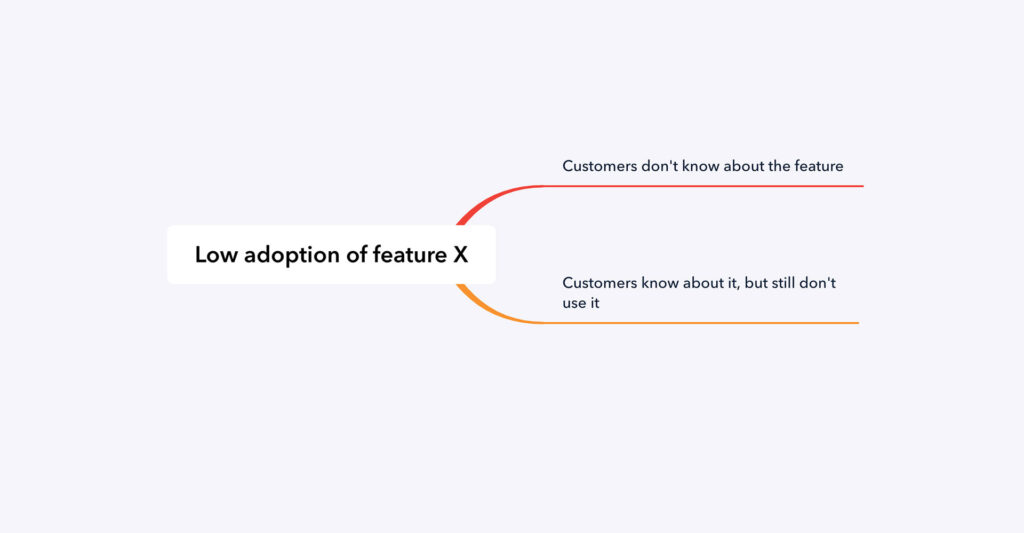
What Is an Issue Tree?
An Issue Tree is a structured way to break down a complex problem into smaller, mutually exclusive and collectively exhaustive (MECE) parts. It visually maps:
- The core problem
- Primary issue categories
- Underlying causes
- Contributing factors
In UX, issue trees are especially effective when:
- Problems are multi-dimensional (UX + tech + ops + trust)
- Stakeholders have conflicting hypotheses
- Data exists, but insights are fragmented
- Fixes risk by addressing symptoms instead of causes
Why Issue Trees Matter in UX & Product Design
Traditional UX problem statements often oversimplify reality. Issue trees counter this by forcing structured thinking.
Key Benefits
- Align cross-functional teams on what problem we are actually solving
- Prevent overlapping or duplicated root causes
- Reveal hidden dependencies (UX, tech, infra, trust)
- Enable prioritisation based on impact, not opinion
- Create a direct bridge between research → design → delivery
In high-stakes systems like payments or healthcare, this structure is not optional—it’s essential.
Anatomy of an Issue Tree (UX Lens)
A strong issue tree follows a clear hierarchy:
1. Core Problem (Trunk)
A single, clearly articulated user or business problem.
Example:
“Users are abandoning UPI payments or retrying transactions unnecessarily.”
2. Primary Issue Buckets (Main Branches)
High-level, non-overlapping categories that fully cover the problem space.
Typical UX-relevant buckets include:
- User Experience Issues
- Technical Failures
- Trust & Security Concerns
- Information Gaps / Communication Issues
Each branch should answer:
“If this category were fixed, would part of the problem disappear?”
3. Secondary & Tertiary Causes (Sub-branches)
Deeper, evidence-based reasons explaining why each issue exists.
This is where:
- Research findings
- Analytics
- Logs
- Customer complaints
start to connect meaningfully.
How to Create an Issue Tree (Step-by-Step)
Step 1: Define the Problem Precisely
Avoid vague statements like “users face issues.”
Bad:
“UPI flow is confusing.”
Good:
“Users abandon or retry UPI payments due to uncertainty during transaction processing.”
Step 2: Apply the MECE Principle
Each branch must be:
- Mutually Exclusive – no overlap
- Collectively Exhaustive – nothing important missing
If two branches sound similar, they probably are.
Step 3: Break Down Using Evidence, Not Assumptions
Ask repeatedly:
- What causes this?
- Why does this happen?
- What proof do we have?
Use:
- Usability testing
- Funnel analytics
- Drop-off points
- Customer support data
Step 4: Stop at Actionable Depth
Issue trees are not about infinite decomposition.
Stop when:
- A cause can be validated
- A design, tech, or policy action can be proposed
Step 5: Mirror with a Solution Tree
Every issue tree should ideally evolve into a solution tree—mapping fixes back to root causes.
UPI Issue Tree — Example from an HSBC India Project
While working on UPI journeys for a large-scale banking app in India, one recurring pattern emerged:
Users were abandoning payments or retrying transactions, leading to:
- Duplicate debits
- Support calls
- Loss of trust
- Reduced UPI adoption
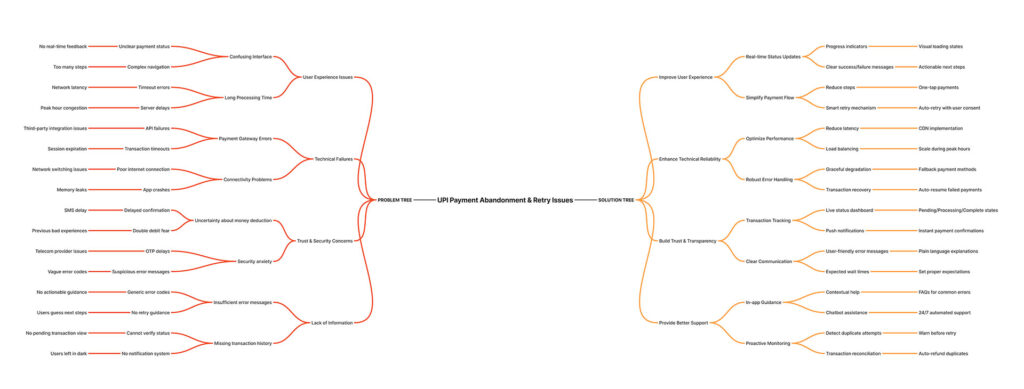
Core Problem
UPI Payment Abandonment & Unnecessary Retries
Key Issue Branches Identified
1. User Experience Issues
- Unclear payment status
- No real-time feedback
- Too many steps
- Confusing navigation
Impact:
Users assume failure and retry.
2. Technical Failures
- Network latency
- Server delays during peak hours
- Third-party gateway timeouts
- Session expiration
Impact:
The transaction state becomes ambiguous.
3. Trust & Security Concerns
- Delayed SMS confirmations
- OTP delays
- Fear of double debit due to past experiences
- Vague error messages
Impact:
Users panic and take defensive actions.
4. Lack of Information
- No pending transaction view
- Generic error codes
- No retry guidance
- Missing transaction history updates
Impact:
Users guess the next step instead of being guided.
From Issue Tree to Solution Tree
Once issues were clearly structured, solutions naturally aligned:
Improve User Experience
- Real-time status indicators
- Clear success/failure messaging
- Reduced steps
- Smart, consent-based retry
Enhance Technical Reliability
- Auto-retry with safeguards
- Graceful degradation
- Load balancing during peak hours
- Fallback payment paths
Build Trust & Transparency
- Live transaction tracking
- Push confirmations
- Plain-language error messages
- Clear expected wait times
Provide Better Support
- Contextual in-app guidance
- Proactive duplicate detection
- Auto-refund reconciliation
- Chatbot + human escalation
The issue tree ensured every solution mapped back to a real cause, not intuition.
Common Mistakes to Avoid
❌ Starting with solutions instead of problems
❌ Overlapping branches (“UX” and “Usability” as separate buckets)
❌ Mixing symptoms with causes
❌ Going too granular without actionability
❌ Treating issue trees as documentation rather than decision tools
When Issue Trees Are Most Powerful
Issue trees shine in:
- Payment & fintech flows
- Enterprise SaaS
- Regulated systems
- Platform redesigns
- High drop-off journeys
- Cross-team alignment workshops
They turn complexity into clarity—and clarity into confident design decisions.
Key Takeaways
- Issue trees are thinking tools, not diagrams
- They force clarity, structure, and evidence-based reasoning
- They align UX, product, tech, and business around the same problem
- Strong issue trees lead to stronger solution trees
- In complex systems, structure is strategy
Future Considerations
As AI-assisted UX, real-time observability, and predictive analytics mature, issue trees will increasingly:
- Be auto-generated from behavioural signals
- Update dynamically with live data
- Power proactive UX interventions
But the core skill will remain the same:
structured thinking rooted in user reality.If you design for complexity, issue trees should be part of your default toolkit—not an exception.