Enboard- Designing a Mobile-First Employee Onboarding Experience for Silicus

Project Overview
Enboard is a mobile onboarding application designed to streamline and humanise the new-employee onboarding experience at Silicus Technologies. The platform was created to replace fragmented, manual onboarding processes with a structured, guided, and self-service digital journey—ensuring new hires feel confident, informed, and connected from day one.
The solution focused on clarity, progress visibility, and trust, while reducing operational dependency on HR and IT teams.
Problem Statement
New employees joining Silicus faced a disconnected and paperwork-heavy onboarding process, characterised by:
- Multiple email threads and offline document collection
- Lack of visibility into onboarding progress
- Repeated follow-ups with HR and IT
- Anxiety around first-day expectations and next steps
From a business perspective, this resulted in:
- High HR operational effort
- Delayed employee readiness
- Inconsistent onboarding experience across locations
Design Objectives
- Create a single, mobile-first onboarding hub
- Provide clear progress tracking for all onboarding tasks
- Reduce HR and IT dependency through self-service workflows
- Establish early trust, transparency, and belonging for new hires
- Ensure scalability across roles, departments, and locations
My Role & Responsibilities
Lead UX Designer
- UX strategy and end-to-end experience design
- User journey mapping and information architecture
- Mobile UI design and interaction patterns
- Content structuring for onboarding clarity
- Stakeholder collaboration with HR, IT, and Engineering
- Usability validation and iteration
Users & Key Scenarios
Primary Users
- New employees (freshers & lateral hires)
Secondary Users
- HR Operations
- IT & Admin teams
Core Scenarios
- Completing personal and employment details
- Uploading mandatory documents
- Understanding onboarding steps and timelines
- Knowing whom to contact for support
- Preparing confidently for Day 1
Experience Strategy
1. Guided, Step-by-Step Onboarding
Onboarding was broken into clear, logical sections:
- Personal Details
- Contact & Education Information
- Employment & Family Details
- Document Uploads
Each step was designed to feel manageable and non-overwhelming, especially on mobile.
2. Progress Visibility & Motivation
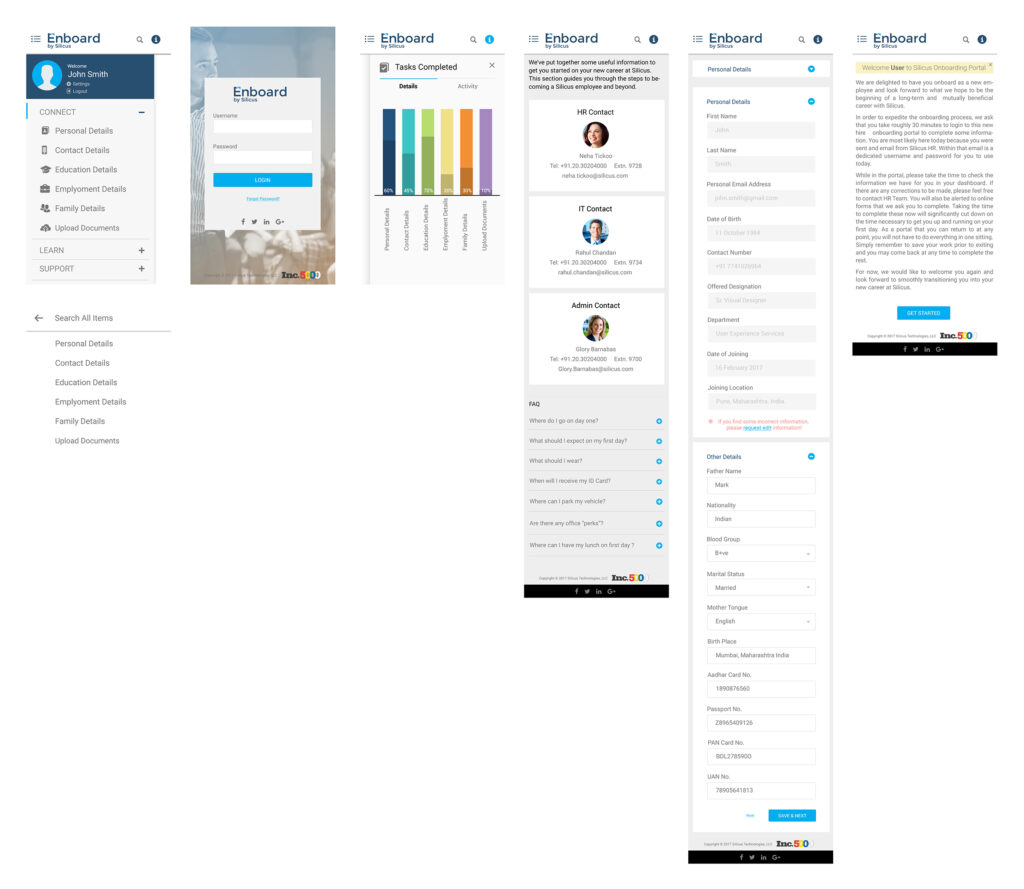
A visual task completion dashboard shows:
- Percentage completion per section
- Pending vs completed tasks
- Clear sense of momentum
This reduced uncertainty and encouraged completion without external reminders.
3. Human Support, Digitally Delivered
Instead of forcing users to “figure things out,” Enboard integrates:
- HR, IT, and Admin contact cards
- Contextual FAQs addressing first-day concerns
- A welcoming onboarding message to set expectations
This balanced automation with human reassurance.
4. Mobile-First, Form-Optimised UI
Given frequent mobile usage:
- Large tap targets and clear field labels
- Minimal cognitive load per screen
- Inline validation and error prevention
- “Save & Next” progression to avoid form fatigue
Key Screens & UX Rationale
Login & Welcome
- Establishes trust and brand tone
- Sets expectations for the onboarding journey
Task Completion Dashboard
- High-level snapshot of onboarding status
- Reduces anxiety through clarity
Personal & Employment Forms
- Chunked data entry to improve completion rates
- Sensitive data handled with clarity and reassurance
Support & FAQ Section
- Proactively answers common first-day questions
- Reduces HR follow-ups
Outcomes & Impact
Employee Experience Impact
- Faster onboarding completion
- Increased confidence before Day 1
- Reduced ambiguity and stress
Business & Operational Impact
- Significant reduction in HR manual coordination
- Standardised onboarding across teams
- Scalable solution for future hiring growth
Design Principles Applied
- Clarity over completeness
- Progress over pressure
- Human warmth within enterprise systems
- Mobile usability as a default, not an afterthought
Reflection & Learnings
This project reinforced the importance of experience design beyond interfaces. Onboarding is an emotional moment—users are forming their first impression of a company. By combining structured workflows with empathy-driven design, Enboard transformed a traditionally administrative process into a welcoming, confidence-building experience.
How This Case Study Positions Me
This work demonstrates my ability to:
- Design enterprise-scale UX systems
- Align user experience with HR and business outcomes
- Lead UX from strategy to execution
- Translate complex workflows into simple, human-centric journeys