
Human-Centered Design for Kohler’s Smart Bath IoT App

Designing an Intelligent, Personalised Bathing Experience
Client: Kohler India
Product: Kohler Smart Bath IoT Mobile Application (DTV+ Digital Showering System)
Platform: iOS / Android
Role: Lead UX Designer – Experience Strategy, Interaction Design, UX Architecture
Timeline: 10–12 weeks
Team: UX, Visual Design, Product, Engineering, Hardware Integration
1. Project Overview
Kohler’s DTV+ system transforms traditional bathrooms into connected, intelligent spaces—allowing users to control water temperature, outlets, steam, lighting, music, and presets through a single mobile app.
The challenge was to design a premium, intuitive, and fail-safe IoT experience for a high-value hardware ecosystem, balancing luxury, safety, and real-world usability in wet, time-sensitive environments.
This project focused on end-to-end UX design of the DTV experience—from device discovery to daily rituals like morning showers, steam sessions, and custom presets.
2. Problem Statement
Despite advanced hardware capabilities, smart bathing experiences often fail due to:
- Over-complex controls for everyday users
- Poor mental models around zones, valves, and outlets
- Safety risks from temperature misconfiguration
- Lack of clarity when systems are warming up, running, or locked
- Inconsistent interaction patterns across shower, steam, and presets
Business Risk:
A confusing experience could undermine Kohler’s premium brand promise and increase service/support dependency.
3. Design Goals
- Simplify complexity without reducing control
- Make temperature, zones, and outlets instantly understandable
- Design for hands-free, glanceable, low-attention interactions
- Ensure safety, predictability, and system transparency
- Enable personal rituals through presets and automation
- Deliver a luxury-grade digital experience aligned with Kohler’s brand
4. User Context & Scenarios
Primary Users
- Homeowners with premium bathrooms
- Families sharing zones and presets
- Wellness-focused users using steam and ambient lighting
Key Usage Moments
- Early-morning quick showers
- Evening relaxation/steam sessions
- Multi-user households with different preferences
- Guests unfamiliar with the system
5. UX Strategy & Experience Architecture
5.1 Core Mental Model
The experience was structured around three primary user intents:
- Control Now – Start shower/steam immediately
- Customise – Adjust temperature, outlets, lighting, and steam
- Automate – Save and run presets
This led to a mode-based navigation system:
- Shower
- Outlet
- Steam
- Ambient / Music
- Presets
Each mode followed the same interaction grammar to reduce learning cost.
6. Key UX Solutions
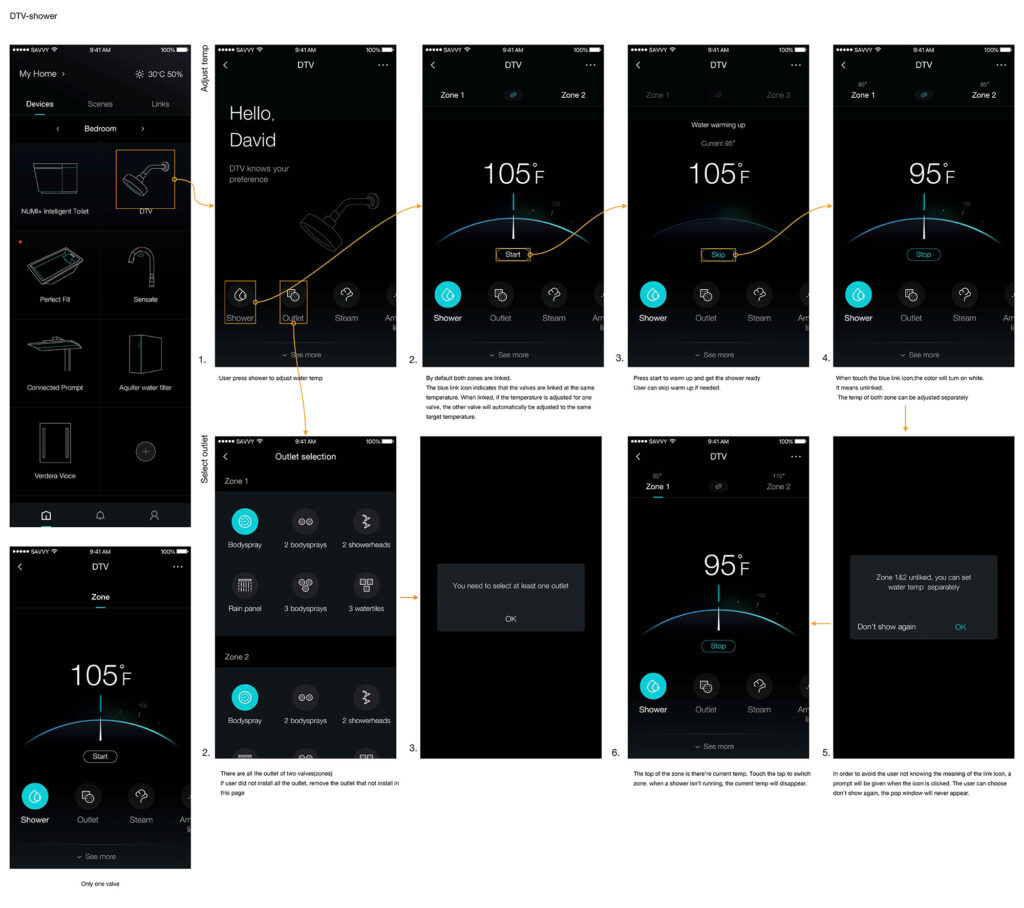
6.1 Intelligent Temperature Control (Zones & Valves)
Problem:
Users struggled to understand whether zones were linked or independent.
Solution:
- Clear visual indicator for linked vs unlinked zones
- Single-gesture temperature adjustment when linked
- Contextual education prompt (with “Don’t show again” option)
- Real-time temperature feedback during warm-up
Impact:
Reduced configuration errors and improved first-time success rate.
6.2 Warm-Up & System State Transparency
Problem:
Users were unsure if the system was ready or still warming.
Solution:
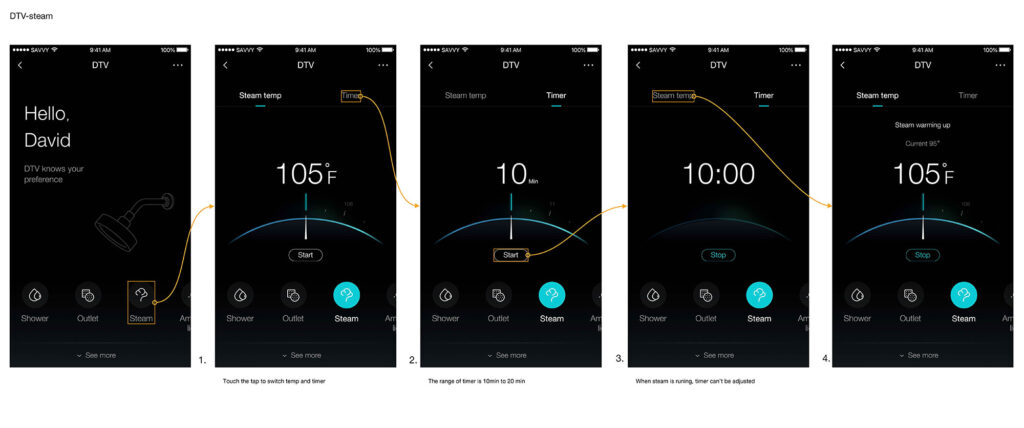
- Explicit “Water warming up” and “Steam warming up” states
- Disabled controls during system-locked phases
- Clear Start / Stop / Skip actions
UX Principle:
Never leave the user guessing in a physical-world interaction.
6.3 Outlet Selection & Validation
Problem:
Users could start a shower without selecting an outlet.
Solution:
- Mandatory outlet selection with clear error messaging
- Zone-wise outlet grouping
- Visual icons mapped to physical fixtures (body spray, rain panel, showerhead)
6.4 Steam Experience with Timer Control
Problem:
Steam sessions require time-bound safety and clarity.
Solution:
- Toggle between Steam Temperature and Timer
- Fixed safe ranges (10–20 mins)
- Timer lock once steam is running
- Unified visual language with shower controls
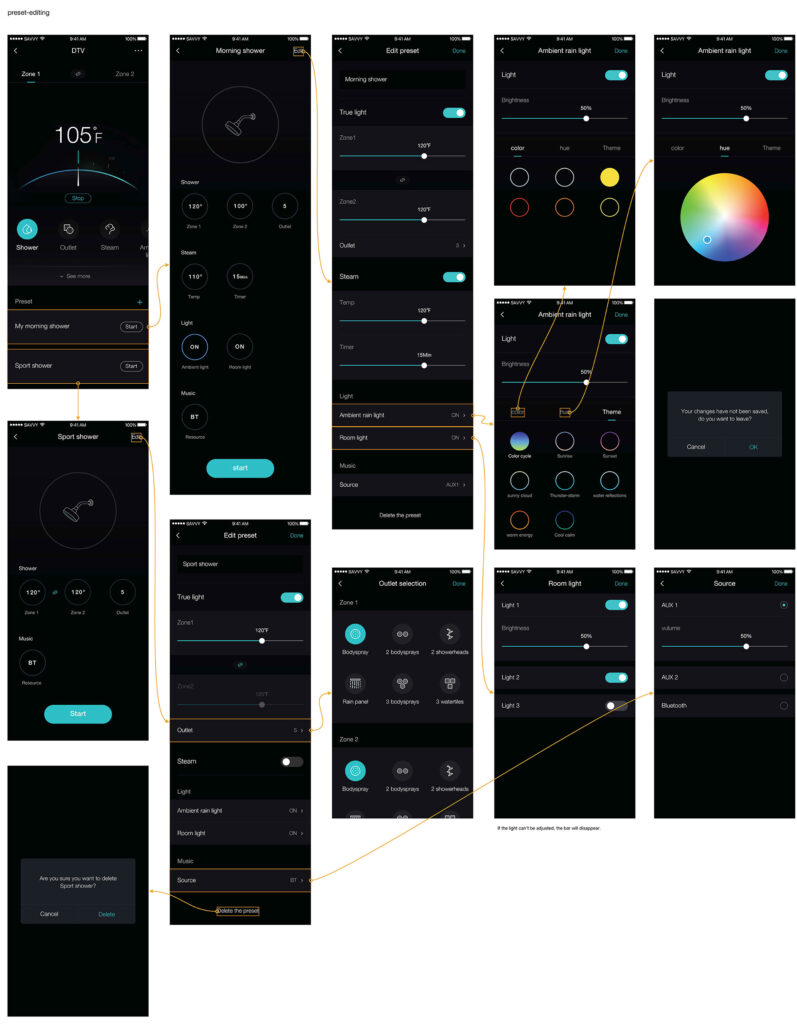
6.5 Presets: Designing for Rituals
Problem:
Users wanted repeatable experiences without reconfiguration.
Solution:
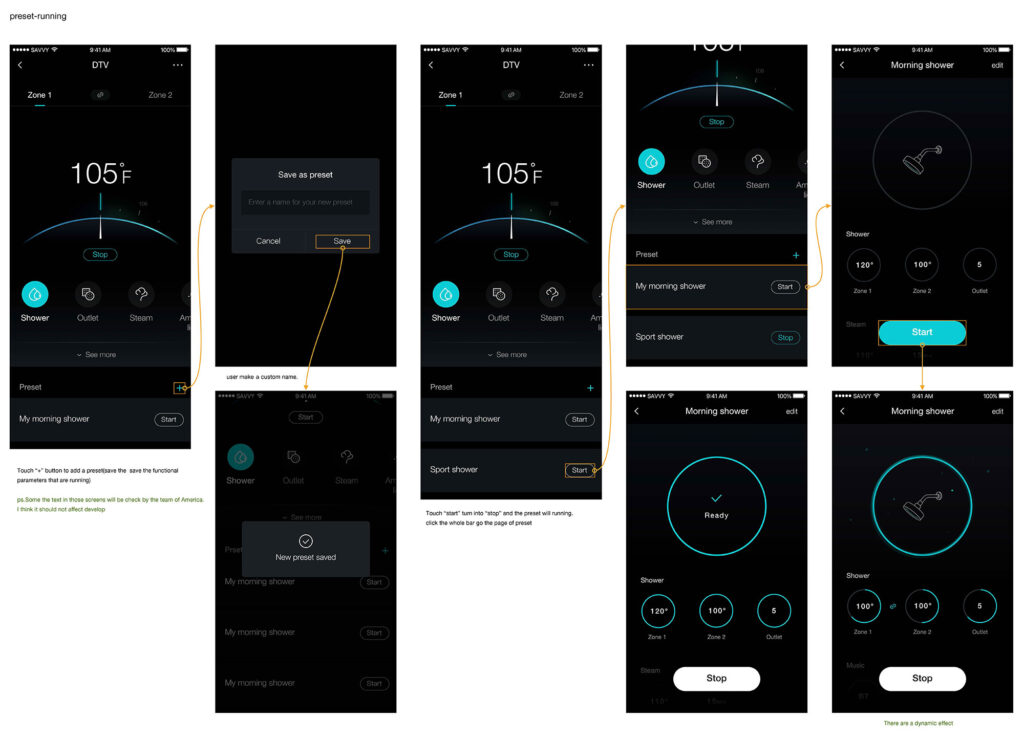
- One-tap preset saving during an active session
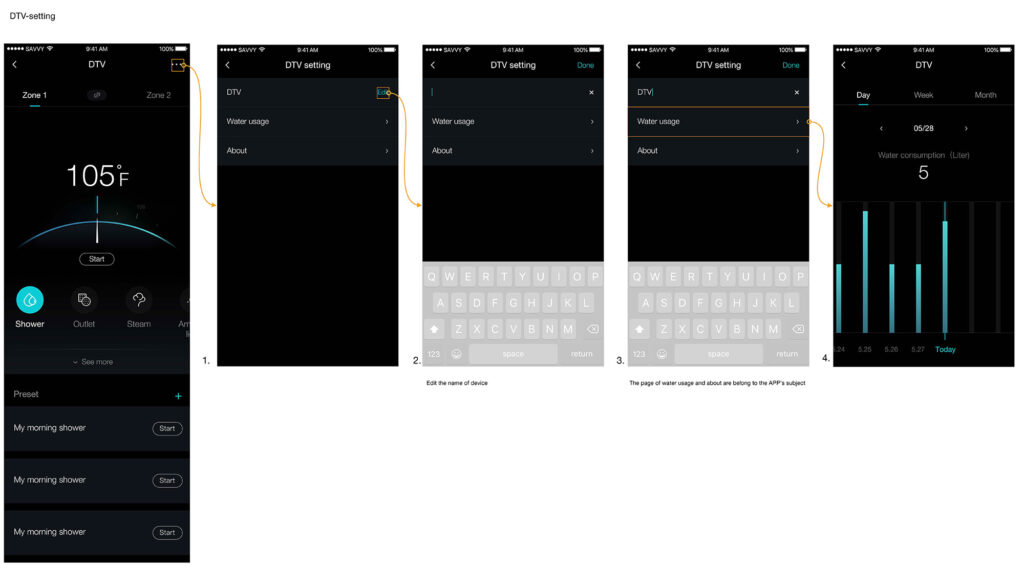
- Editable presets with full control over:
- Zones & temperature
- Steam
- Outlets
- Lighting & ambiance
- Music source
- Dedicated Preset Running Mode with minimal UI
Result:
Turned a functional app into a daily habit-forming experience.
6.6 Ambient Lighting & Emotional Design
Problem:
Lighting and mood settings were secondary but emotionally important.
Solution:
- Theme-based lighting (Sunrise, Sunset, Rain, Calm)
- Colour wheel for advanced users
- Brightness control with instant preview
- Clear separation between room light and ambient rain light
7. Visual & Interaction Design
- Dark UI optimised for bathroom lighting conditions
- High-contrast typography for quick legibility
- Circular temperature arcs reinforcing physical control metaphors
- Large touch targets for wet-hand usage
- Micro-animations for state confirmation and delight
8. Accessibility & Safety Considerations
- Temperature caps to prevent scalding
- Locked controls during active flows
- Clear destructive actions (Delete preset, Stop system)
- Minimal text + icon-first communication
- Error prevention over error correction
9. Outcomes & Impact
- Delivered a cohesive, premium IoT experience aligned with Kohler’s brand
- Reduced cognitive load in high-risk interactions
- Enabled personalisation at scale without complexity
- Created a reusable UX framework for future Kohler smart products
- Strengthened Kohler’s positioning in luxury smart bathrooms
10. What I’m Most Proud Of
- Translating hardware complexity into human-centric simplicity
- Designing for real-world constraints, not ideal conditions
- Balancing luxury aesthetics with operational safety
- Creating an experience that feels effortless, calm, and intentional
11. Key UX Learnings
- IoT UX succeeds when the system state is always visible
- Presets are not shortcuts—they are emotional anchors
- Safety-critical UX must guide, not warn
- Consistency across modes builds trust faster than feature richness